
Why Local Authorities Need More Than a Website
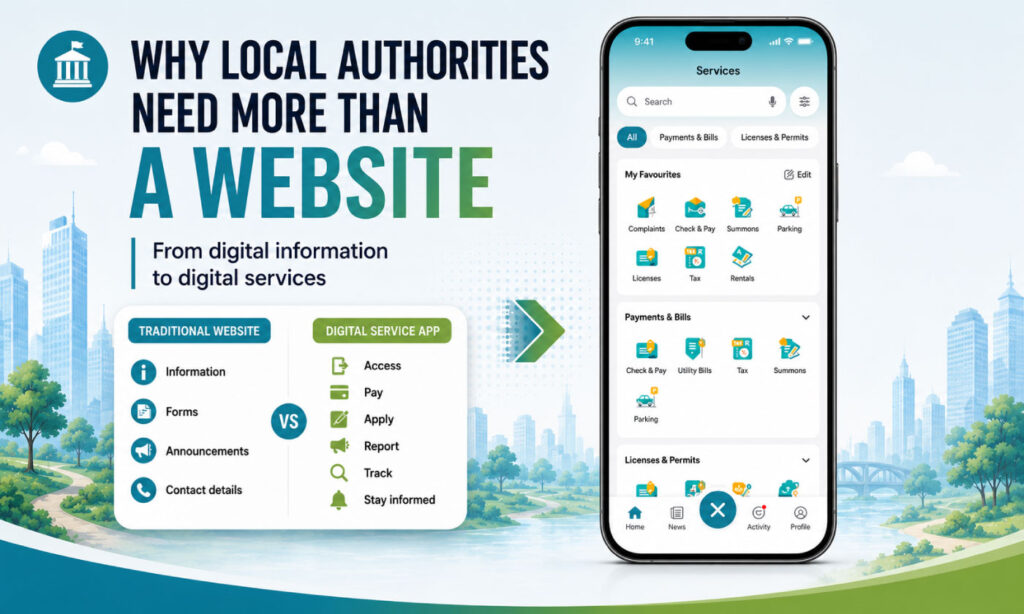
A local authority website is often the first place residents go when they need information.
They may want to check a payment, find a form, look up a service, check an announcement or find the right department to contact.
But there is an important difference between putting information online and delivering a digital service.
A website can tell residents what to do.
A digital service should help them get it done.
As local authorities continue to modernise their service delivery, this distinction is becoming more important.
Malaysia’s Smart City Framework highlights areas including digital infrastructure, digital readiness, public participation and the use of digital platforms to support interaction between communities and local authorities.
KPKT’s current digitalisation work for PBTs also focuses on improving the efficiency and quality of service delivery to citizens.
So the question is no longer simply:
“Does our council have a website?”
A better question is:
“Can residents actually complete what they need to do digitally?”
What Is the Role of a Local Authority Website?
A website still plays an important role.
It provides a central place for a local authority to publish information such as:
- Council announcements
- Contact information
- Service information
- Forms and documents
- News and events
- Policies and notices
- Council programmes
For information, a website works well.
The problem starts when residents need to take action.
For example:
“I want to pay my compound.”
“I need to apply for a licence.”
“I want to report a problem.”
“I submitted an application. What is the status?”
These aren’t simply information requests.
They are service interactions.
And that is where a traditional website can reach its limits.
Information Is Not the Same as a Digital Service
Consider two different experiences.
Experience 1: Finding information
A resident visits the council website.
They search for a licence application.
They find the information.
They download a form.
They fill it in.
They may then need to submit it through another channel.
Experience 2: Completing a digital service
The resident opens a digital council platform.
They select:
Licences → Apply → Submit → Track
The process is completed within the same digital environment.
The difference is simple:
The first experience provides information.
The second helps the resident complete a task.
This is an important shift for local authorities considering digital transformation.
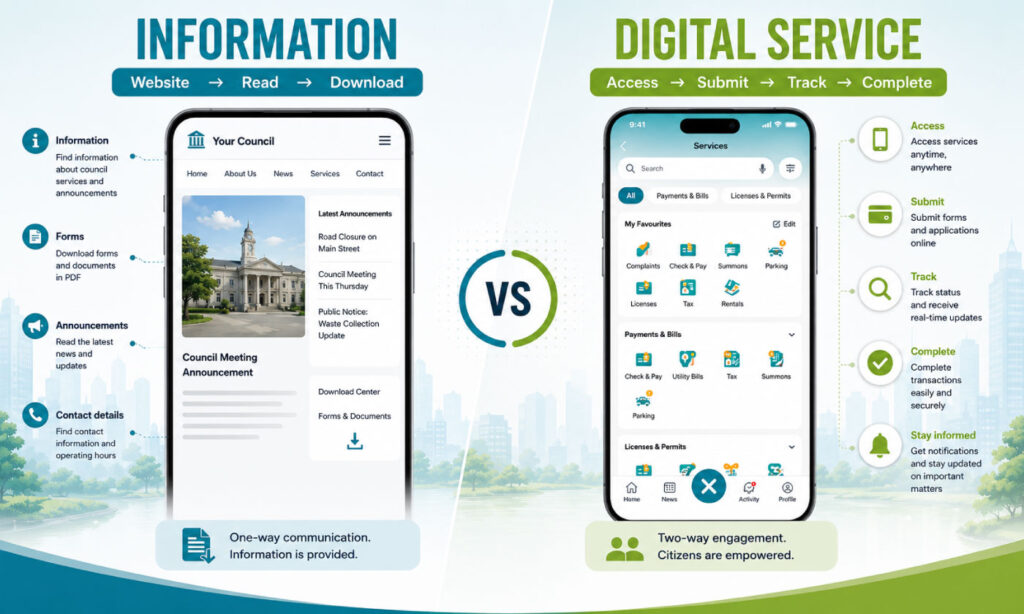
A Website Is One Part of the Digital Experience
A local authority does not necessarily need to replace its website.
In fact, that may not be the right approach.
A website and a digital service platform can serve different purposes.
| Local Authority Website | Digital Service Platform |
|---|---|
|
Provides information |
Enables transactions |
|
Publishes announcements |
Enables service requests |
|
Explains services |
Allows users to access services |
|
Provides forms |
Supports digital applications |
|
Mostly one-way communication |
Enables two-way interaction |
|
Users find information |
Users complete tasks |
|
Good for information discovery |
Good for service delivery |
The goal isn’t:
Website or app?
The better question is:
What does the resident need to accomplish?
What Do Residents Actually Need From Digital Council Services?
Residents usually don’t think in terms of government departments or technology platforms.
They think in terms of tasks.
They want to:
- Pay a bill
- Pay a compound
- Apply for a licence
- Book a facility
- Submit a complaint
- Check an application
- Find council information
- Receive an important update
That means digital services should be designed around what people need to accomplish, rather than how the council’s internal departments are organised.
Instead of asking residents:
“Which department handles this?”
the digital experience should help answer:
“What do I need to do?”
That is a much more useful way to design a citizen experience.
Why Multiple Digital Channels Can Become a Problem
Digital transformation can sometimes create another problem.
A council may introduce:
- A website
- A payment portal
- A complaints system
- A licensing portal
- A mobile app
- A separate event platform
Each system may solve a specific problem.
But from the resident’s perspective, it can become confusing.
“Which platform should I use?”
Residents may have to remember different:
- URLs
- Usernames
- Passwords
- Applications
- Processes
When information and services are spread across different systems, the experience can become fragmented.
The objective should not be to create more digital channels.
It should be to make existing services easier to access.
Web.Plus Perspective
Digital transformation should not be measured by how many platforms a local authority launches.
The more useful question is whether those platforms make everyday services easier for the people using them.
At Web.Plus, we see digital transformation as more than putting existing processes online.
The real opportunity is to reduce unnecessary steps between a local authority and its community.
A resident shouldn’t need to understand how a council is structured before they can access a service.
They should be able to think:
“This is what I need.”
Then find a simple way to do it.
That is the difference between digitising information and digitising the service experience.
This Is Where the Smart City Conversation Changes
When people hear smart city, they often think about:
- Sensors
- IoT
- Traffic systems
- Smart buildings
- Data platforms
- Digital infrastructure
These technologies have an important role.
But smart-city development is also about how technology improves everyday services and the experience of the people living in a community.
Malaysia’s Smart City Framework specifically includes enhancing public participation and using digital platforms to support two-way interaction between communities and local authorities.
That is an important point.
A smart city should not only be technologically connected.
It should also be service-connected.
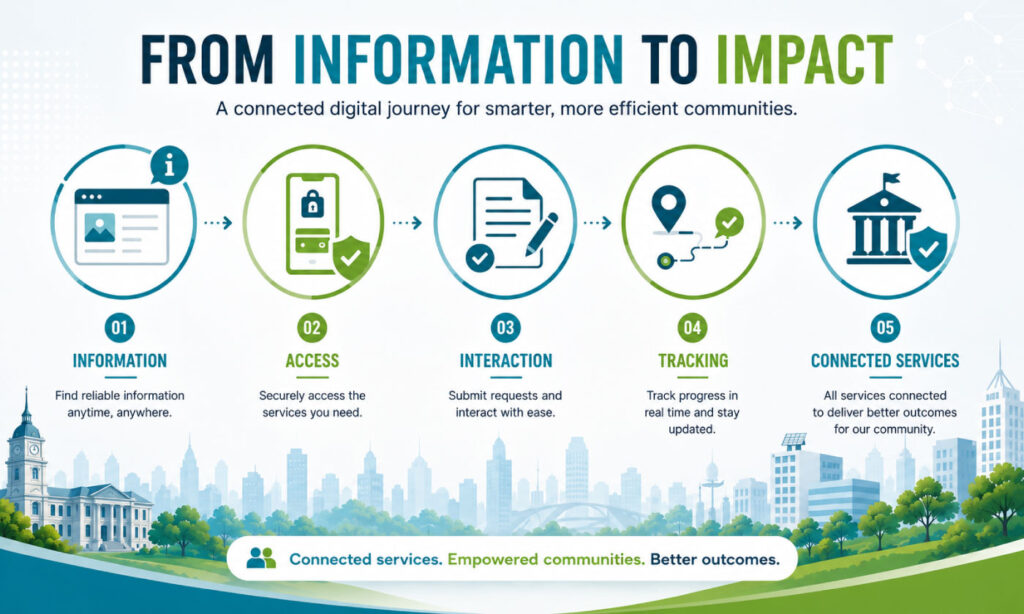
From Digital Information to Digital Services
Think about the journey in five stages:
1. Information
“Here is what you need to know.”
↓
2. Digital Access
“Here is where you can access the service.”
↓
3. Digital Interaction
“You can submit your request online.”
↓
4. Digital Tracking
“You can see what happens to your request.”
↓
5. Connected Digital Services
“You can access multiple services through one connected experience.”
The further a local authority moves along this journey, the less effort residents need to spend navigating the system.
What Should a Digital Council Platform Offer?
Payments
Residents may be able to pay:
- Taxes
- Bills
- Compounds
- Other council-related charges
Applications
Residents may be able to apply for:
- Licences
- Permits
- Rentals
- Facilities
Complaints and Requests
Residents can:
- Report issues
- Submit complaints
- Provide information
- Follow up on requests
Tracking
Residents can see the status of:
- Applications
- Complaints
- Requests
Information and Notifications
Residents can receive:
- Council announcements
- Service updates
- Notifications
- Relevant community information
Komuniti+‘s current service proposition is built around these practical use cases, including payments, applications, complaints, tracking and council information.
The key isn’t the number of features.
The key is whether those features solve real resident needs.
A Better Digital Experience Starts With Fewer Steps
Take a simple example.
A resident wants to report a blocked drain.
Traditional process
Search Google.
↓
Find the council website.
↓
Find the right department.
↓
Find the complaint page.
↓
Find the form.
↓
Submit the complaint.
↓
Wait for an update.
↓
Search again to find the status.
That can feel complicated.
A more connected digital journey could be:
Digital service journey
Open platform
↓
Report an issue
↓
Submit
↓
Track status
↓
Receive update
The technology behind this may be complex.
But the user experience shouldn’t be.
One Platform Can Create a More Connected Experience
This is where the idea of a smart city super app becomes interesting.
Instead of creating a separate digital destination for every service, a local authority can bring multiple everyday services together into one platform.
The principle is simple:
One place to access multiple services.
For residents, that can mean fewer platforms to remember.
For local authorities, it can create a more consistent digital touchpoint with their communities.
And for the wider ecosystem, it creates opportunities to connect:
Local Authorities
Communicate
Deliver services
Manage requests
↓
Communities
Access services
Submit requests
Receive updates
↓
Local Businesses
Connect with local communities
↓
One Connected Digital Community
Where Komuniti+ Fits
This is the thinking behind Komuniti+, Web.Plus’s smart city solution.
Komuniti+ is positioned as:
One App. One Account. One simpler way to connect with your council.
The platform brings multiple council services into one digital environment, including:
Access to council services
- Payments
- Licence and permit applications
- Rentals and facilities
- Complaints and community issues
- Application and request tracking
- Council information
- Notifications and updates
The intended user journey is simple:
Sign Up → Choose a Service → Submit & Track
The point isn’t simply to create another app.
It is to create a simpler digital connection between the council and its community.
What This Means for Local Authorities
The goal of digital transformation shouldn’t simply be:
“We need an app.”
It should be:
“We need to make our services easier to access.”
An app is simply one possible delivery mechanism.
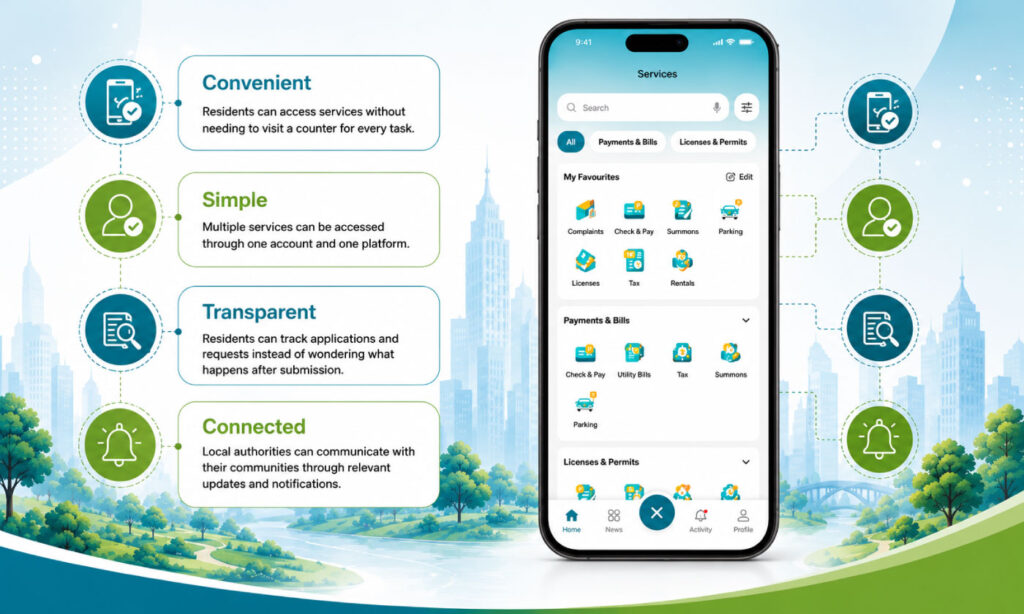
The bigger opportunity is to create a digital experience that is:
Convenient
Residents can access services without needing to visit a counter for every task.
Simple
Multiple services can be accessed through one account and one platform.
Transparent
Residents can track applications and requests instead of wondering what happens after submission.
Connected
Local authorities can communicate with their communities through relevant updates and notifications.
These principles are also reflected in the Komuniti+ proposition.
The Real Goal Isn't to Replace the Website
This is important.
A website isn’t obsolete.
It still has an important role in:
- Providing information
- Publishing announcements
- Sharing documents
- Explaining services
- Providing official information
- Helping residents discover services
But it shouldn’t necessarily be expected to do everything.
Think of it this way:
Website – “Here is what you need to know.”
Digital service platform – “Here is what you can do.”
Connected digital community – “Here is how you can participate.”
That is a more useful way to think about digital transformation.
What Should Local Authorities Consider Before Launching a Digital Platform?
Technology should come after the problem has been clearly defined.
Before investing in another digital platform, ask:
1. What services do residents use most?
Start with actual demand.
2. Where are residents experiencing friction?
Look for unnecessary steps, repeated visits and confusing processes.
3. How many digital platforms are already being used?
More platforms don’t automatically mean better digital services.
4. Can services be brought together?
Look for opportunities to simplify the user journey.
5. Can residents track what happens after submission?
Visibility is an important part of a good digital experience.
6. How will the council measure success?
Don’t measure success simply by the number of app downloads.
Look at:
- Service usage
- Digital transactions
- Completion rates
- Response times
- User satisfaction
- Repeat usage
The ultimate question is:
Are residents getting things done more easily?
A Smarter Council Is Not Necessarily the One With the Most Technology
A local authority doesn’t become smarter simply because it has more apps, sensors or platforms.
Technology is only useful when it improves something.
A better smart-city question is:
Can technology make everyday interactions between the council and its community simpler, faster and more transparent?
That’s where digital transformation becomes meaningful.
The objective isn’t to create more technology for residents to learn.
It’s to create less friction for residents to deal with.
Frequently Asked Questions
Local authority digital services are online services that allow residents and businesses to interact with their local council digitally. Examples include payments, licence applications, facility bookings, complaints, service requests and tracking.
Digital services can make it easier for residents to access services, submit requests, make payments, track applications and receive updates without relying entirely on physical counters or disconnected processes.
Conclusion
A local authority website still matters.
But a website should not be the end goal of digital transformation.
The bigger question is whether residents can access services, complete tasks, communicate with the council and track what happens next without unnecessary friction.
That’s the shift from:
Digital information
↓
Digital services
↓
Connected communities
For local authorities looking to create a simpler digital experience, Komuniti+ provides a platform for accessing council services, making payments, submitting complaints, managing applications and staying informed.
One App. One Account. One simpler way to connect with your council.
Interested in creating a more connected digital experience for your community?
Talk to Web.Plus about Komuniti+.