


What SMEs Need to Know About Cybersecurity in the Age of AI
For years, phishing prevention followed a familiar strategy: secure email systems, block malicious links, train users to identify suspicious messages, and strengthen the infrastructure attackers traditionally abused.
On paper, those efforts have been successful.
Organizations have invested heavily in email security technologies such as DMARC (Domain-based Message Authentication, Reporting, and Conformance), secure email gateways, browser protections, domain monitoring, and employee cybersecurity awareness training. As a result, users today are far more likely to question suspicious emails than they were a decade ago.
As email became harder to exploit, attackers shifted toward platforms where trust is easier to manipulate and security controls are often less effective: social media.
Today, social media impersonation has become one of the fastest-growing phishing tactics, allowing cybercriminals to impersonate brands, executives, customer support teams, influencers, and public figures in order to deceive users.
The phishing attack of today often starts with a fake social media account rather than an email.
The Rise of Social Media Impersonation
Social media impersonation involves the creation of fake profiles, pages, advertisements, or accounts that closely resemble legitimate organizations or individuals.
These fake accounts are commonly used to:
- Distribute phishing links
- Promote investment scams
- Steal login credentials
- Conduct payment fraud
- Spread malware
- Collect personal information
Unlike traditional phishing emails, social media scams often rely on direct engagement and trust-building before directing victims to malicious websites or payment portals.
According to the U.S. Federal Trade Commission (FTC), social media scams now generate significantly higher losses than many traditional scam channels. Reported losses linked to social media fraud have increased dramatically in recent years, highlighting how attackers are successfully exploiting these platforms.
From Single Emails to Multi-Channel Attacks
Traditional phishing campaigns were relatively simple:
- Send a phishing email
- Convince the victim to click a malicious link
- Steal credentials or sensitive information
Modern phishing attacks are far more sophisticated.
Today, attackers often operate across multiple channels simultaneously, including:
- X (formerly Twitter)
- TikTok
- Telegram
- SMS
A victim may first encounter a fake social media profile, engage with a fraudulent customer support account, click a sponsored advertisement, or receive a direct message before ultimately being redirected to a phishing website.
These attacks are no longer isolated incidents. They often function as coordinated ecosystems involving multiple accounts, platforms, and touchpoints.
Why Cybercriminals Love Social Media
Built-In Trust
Social media platforms are built around identity. Users expect to interact with brands, companies, customer service representatives, and public figures through official-looking profiles. A well-designed impersonation account that copies logos, profile images, bios, and content can appear legitimate at first glance. Instead of spoofing infrastructure, attackers are now impersonating identity.
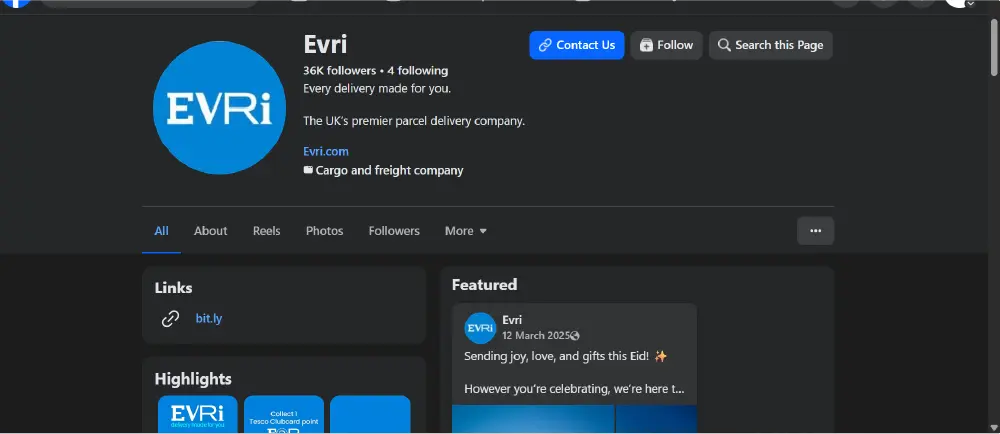
Figure 1. Official Evri Facebook page. Unlike impersonation accounts, the legitimate page links to the company’s official website, maintains verified brand information, and serves as an authorized communication channel for customers.
Figure 2. Fraudulent Facebook page impersonating Evri customer support. The fake account uses the company’s name, branding elements, and customer service messaging to appear legitimate while directing users toward unofficial communication channels.
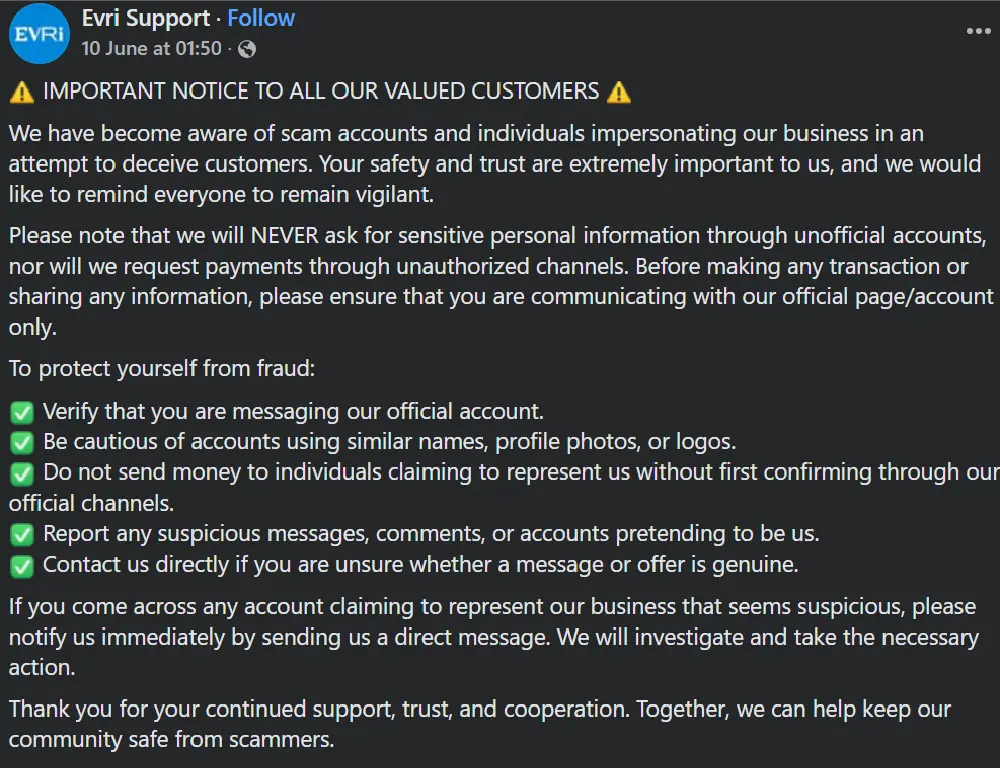
Figure 3. Official fraud warning published by Evri on social media, alerting customers about impersonation accounts pretending to represent the company.
Massive Scalability
Creating social media accounts is fast, inexpensive, and highly scalable.
Cybercriminals can create hundreds of fake accounts, test different branding approaches, and quickly replace accounts that are suspended.
This level of scalability is often easier than operating large-scale email phishing campaigns.
Real-Time Engagement
Unlike email, social media enables immediate interaction.
Attackers can:
- Respond to messages
- Answer questions
- Build trust over time
- Adapt their tactics dynamically
This interactive approach often makes scams appear more convincing than traditional phishing emails.
The Growing Blind Spot for Security Teams
Most phishing prevention programs were built around:
✅ Email security
✅ Domain monitoring
✅ Website protection
✅ Malicious URL detection
However, many organizations have limited visibility into:
❌ Fake social media profiles
❌ Impersonation pages
❌ Fraudulent customer support accounts
❌ Scam advertisements
❌ Messaging platform scams
Unlike phishing websites, social media threats are often hidden behind platform restrictions, private messaging systems, and constantly changing user-generated content.
This makes detection significantly more challenging.
In many cases, security teams simply cannot investigate what they cannot easily see.
Why Brands Need Digital Brand Protection
As phishing campaigns increasingly move to social media, protecting corporate email and websites alone is no longer sufficient.
Organizations must expand their security strategies beyond traditional infrastructure and adopt a comprehensive digital brand protection approach that monitors how their brand is being used or abused across the internet.
An effective digital brand protection strategy typically includes:
Social media monitoring to detect fake profiles and impersonation accounts
Domain monitoring to identify lookalike or typosquatting domains used for phishing
Brand abuse detection across websites, marketplaces, and mobile applications
Takedown services to remove fraudulent websites, social media accounts, and malicious content
Threat intelligence to identify emerging phishing campaigns targeting customers or employees
By proactively monitoring and responding to online brand abuse, organizations can reduce the risk of fraud, protect customer trust, and minimize reputational damage.
In today’s threat landscape, digital brand protection is no longer just a marketing or legal concern, it has become an essential component of cybersecurity.
Why Verification Badges Are Not Enough
Many users assume that a verification badge automatically guarantees legitimacy.
Unfortunately, that is not always true. While platform verification can provide additional confidence, scammers continuously adapt their tactics. Fake accounts may appear highly convincing, and some may even exploit naming similarities, copied branding, or misleading content to deceive users. The safest approach is not to rely solely on social media verification badges.
Always Verify Through the Official Website
Before following, messaging, purchasing from, or sharing information with a social media account:
✅ Visit the organization’s official website first
✅ Locate the official social media links published on the website
✅ Use those links to access the verified account
✅ Bookmark trusted accounts for future reference
This extra step can significantly reduce the risk of interacting with fraudulent accounts.
If a social media profile cannot be found through the company’s official website, users should exercise additional caution.
How to Protect Yourself from Social Media Phishing
To reduce your risk:
- Verify social media accounts through official websites whenever possible
- Be cautious of unsolicited direct messages
- Avoid clicking links shared by unfamiliar accounts
- Verify customer support contacts independently
- Be skeptical of investment opportunities promoted through social media
- Watch for spelling errors, unusual usernames, or recently created accounts
- Enable multi-factor authentication (MFA) on important accounts
- Report suspicious profiles to the platform immediately
As cybercriminals continue to exploit social media and digital platforms to impersonate trusted brands, organizations need visibility beyond their own networks. Protecting a brand today means monitoring domains, websites, social media platforms, and other online channels where attackers may attempt to deceive customers.
A proactive digital brand protection strategy helps organizations detect threats earlier, respond faster, and maintain the trust they have worked hard to build.